
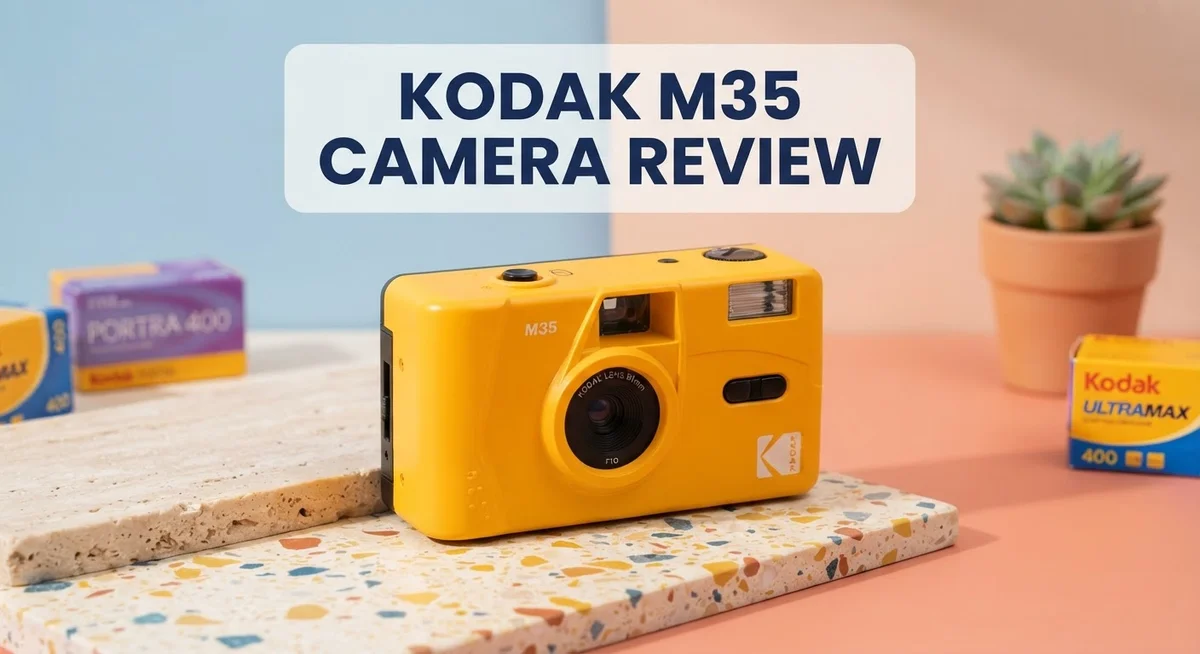
Film photography is making a big comeback. People love the simple, nostalgic feel of shooting on real film again.
The Kodak M35 sits right in the middle of this trend. It brings back the fun of point and shoot cameras without any fuss.
This camera keeps things simple. It has a fixed-focus lens, a built-in flash, and one job: capturing real moments.
You will not find manual settings here. There is no autofocus or fancy aperture control either.
But that is the whole point. The M35 gives you a true lo-fi shooting experience.
In this review, we will look closely at what the Kodak M35 offers. We will check its build, its performance, and who should actually buy one.
If you want an easy way into film photography, this might be it. Let’s dive in and see if this little camera holds up.
In a Nutshell
Here is the quick rundown of the Kodak M35 before you decide if it fits your film journey.
- Fixed everything: The lens, aperture, and shutter stay locked. You just point and shoot without fuss.
- Pocket friendly size: At 114x64mm, it slips into a bag or jacket pocket with ease.
- Flash built right in: Low light shots become possible without extra gear.
- Runs on one AAA battery: No rechargeable batteries or charging cables needed here.
- Frame counter included: You always know how many shots remain on your roll.
- Best suited for casual shooters: This camera works great for parties, trips, or everyday snapshots.
The Kodak M35 skips complicated menus and settings. It hands you a camera that just works. If you want quick, grab and go film shots, this little device delivers exactly that experience.
Optical Design and Lens Quality
The 31mm fixed-focus plastic lens forms the heart of the M35’s optical system. This lens delivers a standard field of view that works well for everyday shooting. You get a wide enough perspective to capture scenes without distortion, yet tight enough to frame subjects clearly.
The F10 aperture sits permanently open at this single setting. This means light enters the lens at a fixed rate. The camera does not adjust brightness based on lighting conditions. Instead, you rely on the film’s sensitivity and the built-in flash for darker environments.
Plastic construction keeps weight down and costs low. The lens elements themselves are basic but functional. You will notice some softness around the edges of your images. This characteristic actually contributes to the lo-fi aesthetic many photographers seek. The lens does not try to be sharp or clinical. It simply captures what you point it at.
The optical design prioritizes simplicity over precision. No autofocus means no hunting for focus. No aperture control means no technical decisions during shooting. The lens stays locked at infinity focus, which works for most subjects beyond a few feet away. Very close objects may appear slightly soft, but this is rarely a problem for casual photography.
This straightforward approach has real benefits. You focus entirely on composition and moment, not technical settings. The camera gets out of your way. You just frame and shoot.
The plastic lens does introduce some optical quirks. Vignetting appears in corners on some shots. Color fringing shows up occasionally at high contrast edges. These are not flaws in the traditional sense. They are simply the signature of this optical design.
For casual photographers and beginners, this lens performs admirably. It captures recognizable images in good light. The built-in flash handles dim situations. The optical limitations actually enhance the vintage film look that many shooters desire.
The M35’s lens philosophy is refreshingly honest. It makes no promises of professional optics. Instead, it delivers what you need for simple, fun film photography. The results feel authentic and unpretentious.

- POINT, SHOOT, PRINT – Capture the moment instantly! Just point, shoot, and watch your vibrant 2x3” prints...
- GET THE PERFECT SHOT – Every shot is a masterpiece with auto-flash, fixed focus, and a 10MP resolution that...
- PORTABLE DESIGN – Adventure awaits! This pocket-sized camera comes in fun colors, so you can easily take it...

Last update on 2026-08-29 / Affiliate links / Images from Amazon Product Advertising API.
Build Quality and Materials
The Kodak M35 uses a plastic construction throughout its body and lens system. This material choice shapes the entire shooting experience. The camera weighs almost nothing, making it genuinely pocketable for any adventure.
The body panels snap together with simple plastic clips. You will notice the seams and joints immediately. This is not premium build quality, but it is intentional. The designers chose durability over luxury here. The plastic resists minor drops and bumps better than you might expect.
The 31mm fixed-focus plastic lens sits at the front. It does not contain glass elements like traditional cameras. Instead, the entire optical path uses molded plastic. This keeps manufacturing simple and production fast. The result is a lens that performs its job without pretense.
The flash mechanism uses basic plastic housing. It charges from a single AAA battery. The contacts are metal, but everything else stays plastic. You will hear a faint whirring sound when the flash charges. This mechanical simplicity means fewer things break.
The frame counter dial spins smoothly. The shutter button has a satisfying click. These small details feel solid despite the budget materials. The viewfinder window is clear plastic, not glass. It does not distort your framing much, though it is not perfectly transparent.
The overall aesthetic feels honest and unpretentious. You get exactly what you see. No hidden engineering tricks or surprise features hide inside. The plastic feels slightly tacky to some photographers. Others find this tactile quality charming and authentic.
The materials do show wear over time. Scratches appear on the plastic body. The lens can cloud slightly with age. These marks tell the story of actual use. Many film photographers actually prefer this aged appearance.
The build philosophy prioritizes function over finesse. The M35 survives real world use. It handles casual shooting, travel, and parties without complaint. The materials are not luxury grade, but they are adequate. This straightforward approach appeals to photographers who value experience over equipment perfection.
Ease of Use and Operation
The Kodak M35 strips away all complexity. You pick it up, frame your shot, and press the shutter. That’s it.
There are no buttons to toggle between modes. You won’t find dials for aperture or shutter speed adjustments. The camera handles all technical decisions for you. This approach means beginners jump straight into shooting without learning curves or intimidation.
The physical controls feel intuitive. The shutter button sits where your finger naturally rests. The frame counter dial turns smoothly as you advance film. The flash switch toggles easily between on and off positions. Everything responds to light pressure. Nothing requires force or frustration.
Loading film takes seconds. The back panel opens with a gentle pull. You insert the film canister, thread the leader across the sprockets, and close the back. The camera auto advances as you shoot. Most people complete this task without consulting instructions.
The built in flash activates with a simple slide switch. No external flash units needed here. The battery compartment opens from the bottom with a coin. One AAA battery powers everything for an entire roll of film. Battery life rarely becomes an issue during normal use.
Focusing presents zero challenge. The fixed focus lens keeps everything from roughly three feet onward acceptably sharp. You don’t aim, focus, and shoot. You simply aim and shoot. This removes one mental step from the process.
The viewfinder shows you roughly what the lens captures. It’s small but adequate for framing basic compositions. You see your subject clearly enough to compose straightforward shots.
Operation in different lighting conditions requires no adjustments. The camera performs the same whether you’re indoors, outdoors, or at dusk. The single shutter speed and aperture combination work across most daylight situations. The flash engages automatically when light drops, though you can disable it if preferred.
This camera rewards intuitive, spontaneous shooting. You’ll spend zero time fiddling with settings and maximum time capturing moments. That freedom appeals to casual photographers who want simplicity above all else.
Top 3 Alternatives
Fujifilm Instax Mini

- Compact and cute design. Easily twist the lens to turn on and off
- Built-in selfie mirror for easy selfies Close-up mode with parallax correction
- Features automatic exposure and flash control for bright photos that are not “washed-out”
Last update on 2026-04-26 / Affiliate links / Images from Amazon Product Advertising API.
The Fujifilm Instax Mini is a popular instant camera that produces physical prints right away. You point, shoot, and get a photo in your hands within minutes. The camera uses instant film that comes in various colors and effects.
This camera works great for parties and events. Friends love getting instant photos as memories. The lens is simple to use, and the flash works automatically in low light. You can carry it easily in a bag or backpack.
Canon PowerShot ELPH

- Canon USA Authorized. Items Include: Canon PowerShot ELPH 360 HS A Digital Camera (Silver) and 64GB Memory...
- The Canon PowerShot ELPH 360 HS A features a 20.2MP CMOS sensor and DIGIC 4+ processor for high-resolution...
- A 12x optical zoom lens covers an impressive 25–300mm equivalent focal range, ideal for wide landscapes and...
Last update on 2026-08-29 / Affiliate links / Images from Amazon Product Advertising API.
The Canon PowerShot ELPH is a compact digital camera with a small body that fits in your pocket. It takes sharp photos with good colors. The camera has a zoom lens that lets you capture distant subjects without moving closer.
You can store thousands of photos on a memory card. The screen shows you what the camera sees before you take the shot. Battery life is solid, lasting through a full day of shooting. The camera connects to your phone or computer easily for sharing images online.
Olympus Tough TG

- Waterproof 15 meters (50 feet), Dustproof, Shockproof 2.1 meters (7 feet), Crushproof 100 kilogram-force...
- High resolution F2.0 lens, maximum 4x zoom, true pic VIII, back illuminated CMOS image sensor
- Variable macro system comprised of 4 macro modes, magnified capturing up to 1 centimeter from the end of the...
Last update on 2026-04-26 / Affiliate links / Images from Amazon Product Advertising API.
The Olympus Tough TG is built for adventure and outdoor use. This camera survives drops, water, and dust without problems. You can take it hiking, swimming, or camping without worry.
The camera has a bright screen that works even in sunlight. Photos come out clear and detailed. Rugged design means it handles rough conditions that would damage other cameras. The battery stays strong in cold weather, making it perfect for winter trips.
Flash Performance and Lighting
The Kodak M35 features a built-in flash system that handles low light situations without requiring external equipment. This flash activates through a simple slide switch located on the camera body. You get instant illumination for indoor shots, evening events, or any scene where natural light falls short.
The flash operates on a single AAA battery, which also powers the frame counter and camera mechanisms. One battery covers all your power needs for an entire roll of film. You won’t need to carry separate flash units or worry about complex charging systems.
Flash performance stays consistent across different shooting scenarios. The flash fires at a fixed intensity, meaning you don’t adjust power levels or worry about exposure settings. This simplicity removes guesswork from flash photography. Point, shoot, and the flash handles the rest.
Indoor party photography becomes straightforward with the M35. The flash illuminates subjects at typical room distances without requiring technical knowledge. Group photos at gatherings benefit from the reliable, automatic flash behavior. The camera handles these casual moments naturally.
Evening outdoor shots also work well when ambient light diminishes. The flash fills in shadows and adds light to twilight scenes. Your subjects remain visible and properly exposed without manual intervention. The flash range suits standard shooting distances you’ll encounter regularly.
The flash mechanism uses basic plastic housing, keeping the overall camera lightweight and simple. This straightforward design means fewer parts to malfunction or require maintenance. The reliability comes from minimalist engineering rather than advanced electronics.
One consideration involves flash recycling time. The camera needs a moment between shots for the flash to recharge. Rapid fire photography requires brief pauses between frames. This pace actually encourages thoughtful shooting rather than machine gun clicking.
The flash pairs perfectly with the M35’s fixed aperture and shutter speed. All three elements work together automatically. You focus purely on composition and timing while the camera manages technical exposure. This integration makes flash photography feel effortless for casual users.
Overall, the built-in flash transforms the M35 into a capable low light camera. It handles the situations where fixed focus and automatic settings shine brightest.
Image Quality and Film Compatibility
The Kodak M35 accepts standard 35mm film, which gives you access to a wide range of film stocks available in the market. You can load color negative film, black and white film, or slide film depending on your creative preferences. This flexibility means you’re not locked into one specific film type.
The camera pairs well with consumer grade films like Kodak Gold, Fujifilm Superia, and Ilford XP2. These films work reliably with the M35’s fixed exposure settings. The single 1/120 shutter speed and F10 aperture combination creates a consistent exposure window that suits most daylight and flash scenarios.
Image sharpness depends heavily on your film choice and shooting distance. The 31mm focal length captures a natural, slightly wide perspective that works for everyday moments. Objects at close range may appear softer due to the fixed focus design, but subjects beyond 2 meters typically render with acceptable clarity.
The plastic lens introduces some light falloff at the edges of your frame. Vignetting becomes noticeable on bright, evenly lit scenes. This characteristic isn’t a flaw but rather part of the M35’s visual signature. Many photographers actually embrace this effect as part of the lo-fi aesthetic.
Color rendition stays true when you use quality film stocks. The fixed aperture means colors won’t shift based on lighting conditions like they might with adjustable cameras. Flash photography produces natural looking results indoors, though you may notice slight color temperature differences compared to daylight shots on the same roll.
Grain structure becomes visible depending on your film’s ISO rating. Faster films like ISO 400 show more pronounced grain, while ISO 100 stocks appear smoother. The M35 handles both equally well since it has no ISO adjustment capability.
The camera’s simplicity means what you see is what you get. There’s no metering system to fool you or autofocus to hunt for the right plane. Your image quality outcome rests on three factors: your film choice, your distance from subjects, and available light conditions. This straightforward relationship between camera and film makes the M35 predictable and honest in its results.
Pros and Cons
Pros
- Point and shoot simplicity means you grab it and start shooting without learning curves
- Multiple color options let you choose a camera that matches your style
- Built in flash handles low light situations without needing extra gear
- Single AAA battery powers everything including the flash and frame counter
- Natural 31mm focal length captures everyday scenes without distortion
Cons
- No manual controls means you cannot adjust focus, aperture, or shutter speed for creative shots
- Plastic construction feels cheap and may show wear after regular use
- Fixed aperture and shutter speed limit what you can do in different lighting conditions
- Flash recycling time between shots can feel slow when shooting rapidly indoors
Who Should Buy It
The Kodak M35 works best for people who want simplicity above all else. If you hate complicated cameras, this one is perfect for you. You load film, point, and shoot. That’s it.
Casual photographers love this camera. You don’t need to understand aperture or shutter speed. The M35 makes those choices for you. This means you focus on composition and timing instead of technical settings.
Students and teenagers enjoy the M35 because it’s easy to use. You can grab it and start shooting within seconds. No manuals needed. No learning curve. This appeals to anyone picking up a camera for the first time without wanting to study photography basics.
Travel enthusiasts appreciate the compact design. The camera fits in your pocket or small bag. It weighs almost nothing. You can carry it everywhere without thinking about it. The multiple color options let you pick one that matches your personal style.
People who enjoy lo-fi and vintage aesthetics should consider this camera. The plastic lens creates a specific look that many photographers love. The fixed focus and single shutter speed produce consistent results across different shots. This predictability appeals to artists who want a specific visual style.
The M35 is not for everyone though. If you want creative control, skip it. You cannot adjust focus, aperture, or shutter speed. Professional photographers won’t find value here. Beginners who want to learn photography should look elsewhere too, since this camera teaches you nothing about exposure or manual settings.
People who dislike plastic construction should avoid it. The camera feels cheap. It may show wear after regular use. If durability matters to you, consider alternatives.
The M35 suits anyone who values simplicity and fun over control. It’s for people who want to shoot without thinking. It works for those who appreciate the lo-fi aesthetic. It’s perfect if you just want a camera that works reliably without complications. This camera removes barriers between you and photography.
Final Verdict
The Kodak M35 earns its place as a fun entry point into film photography. It strips away every complicated setting and hands you a simple tool for capturing moments. This camera works best when you accept its limits from the start.
Think of the M35 as a modern toy camera. It brings back the joy of shooting without screens or menus. You point, you shoot, and you wait for results.
Compared to disposable cameras from Fujifilm, the M35 offers one big advantage. You can reload it with any 35mm film you like, again and again. This makes it more sustainable and flexible over time.
Against the YAMA Film MEMO M20, the M35 holds its own with similar simplicity. Both cameras target the same casual crowd who wants easy film shooting. Your choice between them often comes down to color options and personal style.
Harman reloadable cameras sit in a different category. They offer sturdier builds for people who shoot film more seriously. The M35 stays lighter and simpler, which suits a different type of user.
Should you buy the Kodak M35? Yes, if you want a stress free way to try film photography. Yes, if you love collecting quirky cameras in fun colors.
Skip it if you need sharp images or creative control over your shots. Skip it if plastic construction bothers you long term.
For everyone else, this camera delivers exactly what it promises. It gives you a simple, honest film experience without extra frills. No learning curve, no manual adjustments, no stress.
The Kodak M35 won’t replace a serious film camera. But it doesn’t try to. It fills its own space as a fun, low pressure companion for spontaneous shooting.
Grab one, load some film, and start shooting. That’s really all this camera asks of you.
Frequently Asked Questions
Can I use the Kodak M35 in bright sunlight?
Yes, the M35 works well in bright conditions. The fixed 1/120 shutter speed and F=10 aperture are set for daylight shooting. You’ll get sharp, properly exposed images outdoors on sunny days. The camera struggles more in dim indoor spaces, which is why the built-in flash exists. Just remember the flash has limited range indoors.
Does this camera teach me about photography?
Not really. The M35 removes all learning opportunities because you cannot adjust settings. You point, shoot, and move on. If you want to understand how aperture, shutter speed, and focus work together, this camera won’t help. It’s purely a point-and-shoot device. Consider other film cameras if education matters to you.
How durable is the plastic construction?
The M35 feels light and cheap. The plastic body will show scratches and scuffs with regular use. It’s not built to last decades like vintage cameras. However, it survives casual shooting just fine. Don’t expect it to handle rough treatment or drops well. Think of it as a temporary companion, not a lifelong investment.
What film should I load into it?
Standard 35mm film works in the M35. ISO 200 or 400 film performs best with the fixed shutter speed. Slower film (ISO 100) may underexpose in average light. Faster film (ISO 800 or higher) risks overexposure on bright days. Any standard 35mm cartridge loads easily into the camera.
Is the frame counter accurate?
The mechanical frame counter tracks your shots as you wind. It generally stays accurate throughout a 36 exposure roll. Don’t rely on it as your only guide though. Keep mental notes of how many frames you’ve shot to avoid running out unexpectedly.

