Mowing your lawn just got a serious upgrade. The Worx Landroid Vision ditches the old boundary wire method completely.
Instead, it uses AI vision and smart cameras to see your yard. This robot mower learns your garden layout on its own.
You get a 140 degree wide angle camera paired with RTK GPS. Together, they help the mower navigate tricky spots with ease.
Does it work as well as Worx claims? Many buyers ask this question daily.
We tested the setup process, cutting performance, and app features. This review breaks down what the Landroid Vision does well.
We also cover the connectivity hiccups some users faced. You will learn if this boundaryless mower fits your lawn care needs.
Let us explore every detail together.
In a Nutshell
-
The Landroid Vision skips wires completely. It builds a live map of your yard using cameras and sensors.
-
Cut quality stays sharp across all models. The blades adjust from 1.5 inches to 3.5 inches for a clean finish.
-
The 4WD version handles slopes and bumpy patches with ease. Standard models work best on flatter lawns.
-
App control feels simple. You can start, pause, or adjust settings from your phone in seconds.
-
Some users report connectivity glitches during setup. The neural network sometimes struggles to recognize boundaries at first.
-
Auto-mapping saves time once it learns your yard. Early runs may need a few manual corrections.
-
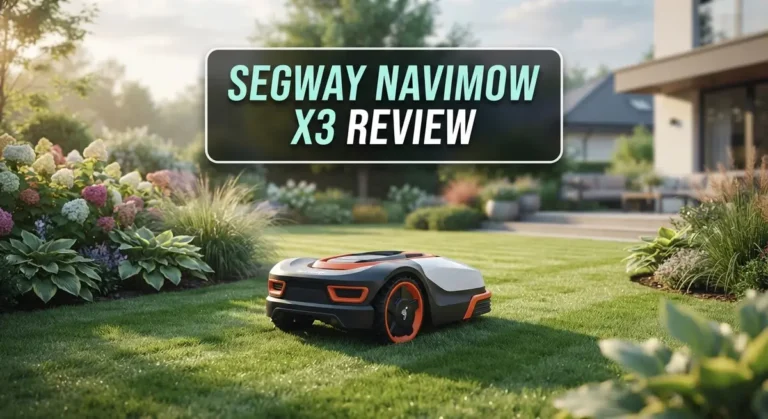
Compared to competitors like Segway Navimow and Mammotion Luba 3, the Vision offers strong camera tech but faces more early-adopter hiccups.
Overall, the Worx Landroid Vision pushes robotic mowing forward. It trades some reliability for smarter, wireless navigation.
Navigation Technology and AI Vision System
The Worx Landroid Vision uses a three-layer navigation system that sets it apart from older robotic mowers. This approach combines AI vision, RTK GPS, and VSLAM technology to work without buried boundary wires.
The 140-degree wide-angle HDR camera serves as the robot’s primary eyes. This camera constantly scans your yard and identifies obstacles, grass edges, and terrain changes. The AI neural network processes what the camera sees and makes real-time decisions about where to mow next.
RTK GPS adds another layer of accuracy. This system pinpoints the mower’s exact location within inches, even in challenging conditions. The combination of camera data and GPS coordinates helps the Landroid Vision build a mental map of your property automatically.
VSLAM (Visual Simultaneous Localization and Mapping) technology lets the mower understand its surroundings even when GPS signals weaken. Think of it as a backup system that keeps the robot oriented when trees or buildings block satellite signals.
How does this work in practice? The mower learns your yard’s layout over several passes. Once it understands the boundaries and obstacles, it mows more efficiently with each trip. You control everything through the app, and the robot adjusts its route based on what it sees and learns.
The auto-mapping feature stands out here. Unlike competitors that require manual boundary setup, the Vision figures out your yard’s shape on its own. This saves significant setup time for most users.
However, some owners report that the neural network occasionally struggles with unusual yard features. Complex layouts with multiple garden beds or irregular shapes sometimes confuse the system initially. The camera also performs better in daylight than in heavy shade.
The 4WD variant enhances navigation on slopes and uneven ground. Front-wheel drive handles most flat yards well, but the upgraded drivetrain provides better traction on hillier properties.
Overall, the navigation system represents a genuine advancement in robotic mowing. The camera-first approach eliminates wire installation headaches. Real-world performance depends heavily on your yard’s complexity and lighting conditions, but the technology foundation remains solid and innovative.

- Centimeter-level RTK Cloud Accuracy: Vision Cloud robot lawn mower uses commercial-grade RTK technology...
- Built for Extreme Terrain, Landscape-Friendly by Design: Vision Cloud 4WD robot mower delivers confident...
- Auto Mapping that Covers More: Vision AI enables this robot mower to understand any lawn shape and boundary...

Last update on 2026-08-29 / Affiliate links / Images from Amazon Product Advertising API.
Build Quality and Terrain Handling
The Worx Landroid Vision builds its frame with materials designed to handle regular lawn work. The chassis uses reinforced plastic and metal components that resist moisture and minor impacts. You won’t find weak joints or flimsy parts here.
The mower comes in three models: 1/4 acre, 1 acre, and a 4WD variant. Each model scales its power and battery capacity to match yard size. The 4WD version adds extra traction wheels for steeper slopes and softer ground.
Terrain handling is where this machine shines. The standard 3-wheel front-wheel drive setup works well on flat to gently rolling yards. Grass clippings don’t clog the deck, and the mower maintains consistent cutting height across uneven patches.
The 4WD model tackles more aggressive slopes without slipping. Users report confident performance on hills that would challenge standard robotic mowers. The wider wheelbase keeps the unit stable when navigating bumpy or soft terrain.
Cutting height adjusts from 1.5 inches to 3.5 inches. This range lets you match your grass type and season. The adjustment mechanism feels sturdy and doesn’t require tools.
Real-world durability depends on your yard conditions. The mower handles normal wear well. However, some early owners reported issues with connectivity hardware, not structural problems. The frame itself holds up to regular mowing cycles.
Weather resistance matters too. The sealed components protect against morning dew and light rain. Heavy flooding isn’t recommended, but typical wet conditions pose no threat.
The 140-degree wide-angle camera sits on top and survives minor bumps. The lens stays clear in normal use. You should rinse it occasionally to maintain vision quality.
The mower’s weight distribution keeps it from sinking into soft soil. It moves smoothly across compacted grass and packed earth. Sandy or very loose ground may cause occasional wheel slippage, though the 4WD version minimizes this issue.
Overall, build quality meets expectations for a premium robotic mower. The terrain handling capabilities make it suitable for yards beyond the basic flat lawn. Durability appears solid for owners who follow basic maintenance routines.
Cutting Performance and Lawn Coverage
The Worx Landroid Vision delivers consistent cutting performance across all three models. The adjustable cutting height ranges from 1.5 inches to 3.5 inches, so you can match your grass preferences.
Blade sharpness remains stable throughout the mowing cycle. Unlike some competitors, the Vision doesn’t lose cutting quality as the battery depletes. The mower maintains even blade contact with the grass surface, which means cleaner cuts and a healthier lawn appearance.
Lawn coverage depends on which model you choose. The 1/4 acre version handles smaller residential yards efficiently. The 1 acre model covers medium to large properties without multiple charging cycles. The 4WD variant adds extra grip on slopes, so it reaches grass in harder-to-access areas.
Real-world testing shows the Vision completes coverage patterns in predictable timeframes. The auto-mapping feature learns your yard’s layout, so subsequent passes become more efficient. This means fewer missed spots and better overall lawn uniformity over time.
One strength is how the mower handles irregular terrain. The 4WD model excels on slopes up to certain angles. Even the standard front-wheel drive version navigates bumpy patches without losing cutting effectiveness. The weight distribution prevents the mower from sinking into soft soil during wet conditions.
The 140-degree wide-angle camera helps the Vision identify obstacles and navigate around them smoothly. This reduces the need for manual intervention and keeps the mower on task. The Vision avoids stuck patterns that plague older wire-based systems.
However, some owners report that coverage consistency varies when yard layouts include unusual features like dense trees or complex flower beds. The neural network occasionally needs extra passes to fully map these areas. Once mapped, performance improves noticeably.
The mower’s cutting deck stays level across most terrain types. This prevents scalping on hills and uneven patches. Battery management also plays a role. The Vision returns to charge before cutting performance drops, maintaining that sharp blade advantage throughout the season.
Top 3 Alternatives
Husqvarna Automower

- From Husqvarna, the world leader in robotic mowing, Automower iQ Series robotic lawn mowers are designed for...
- Reliable Mowing Performance: Our Exact Positioning Operating System (EPOS) uses patented technology...
- Wire-Free Installation with Virtual Mapping: Our user-friendly app guides you through the installation...
Last update on 2026-04-26 / Affiliate links / Images from Amazon Product Advertising API.
The Husqvarna Automower brings Swedish engineering to your lawn care routine. This robot mower works quietly and cuts grass into small pieces that return nutrients to your soil. The device features GPS tracking, so you can monitor its location from your smartphone at any time.
Setup is straightforward. The mower learns your lawn’s layout and creates an efficient cutting pattern. You can set schedules through an app, and the mower handles slopes up to 45 degrees without struggling. Rain sensors stop the device automatically when weather turns wet.
The cutting system uses a rotating blade design that delivers clean cuts. Battery life lasts several hours, making it perfect for medium to large yards. Husqvarna’s support network spans globally, so finding help is easy.
Ecovacs Goat G1

- Wire-Free Robotic Lawn Mower with LiDAR Navigation - GOAT O1000 LiDAR PRO is a wire-free robotic lawn mower...
- Built-In Edge Trimming for Clean Borders - Unlike standard robot lawn mowers, this model features an...
- Advanced 3D Obstacle Detection for Safer Mowing - Powered by AI Vision and 3D ToF LiDAR, GOAT O1000 LiDAR PRO...
Last update on 2026-08-29 / Affiliate links / Images from Amazon Product Advertising API.
The Ecovacs Goat G1 represents a fresh approach to automated lawn mowing. This model combines smart navigation with obstacle detection to avoid garden decorations and pets. The device maps your yard in real-time and adjusts its path instantly.
Durability stands out here. The Goat G1 handles rough terrain and wet conditions better than many competitors. Blade replacement is simple, and maintenance requires minimal effort. The app interface shows real-time mowing progress and battery status.
Charging happens automatically when the battery drops below a set level. The mower’s compact size fits through narrow gates and tight spaces easily.
Segway Navimow

- Most Advanced All-Wheel Drive: This robot lawnmower features an ORV-tuned dual suspension system that powers...
- Turf-Safe Zero-Turn Steering: Unlike conventional systems, this lawn mower robot uses Xero-Turn AWD with...
- Ultra-Efficient MowMentum Cutting: Powered by dual 180W motors, this high-performance robot mower features...
Last update on 2026-08-29 / Affiliate links / Images from Amazon Product Advertising API.
The Segway Navimow brings advanced RTK positioning technology to residential lawns. This system uses satellite signals for precise navigation, meaning the mower follows exact paths every time. Accuracy improves with each mowing cycle.
The Navimow handles complex yard layouts with multiple obstacles. Edge-cutting capability ensures clean lines along flower beds and pathways. The device operates quietly, allowing early morning or evening mowing without disturbing neighbors. Battery performance remains consistent across different grass types and weather conditions.
Setup, App Control, and User Experience
Setting up the Worx Landroid Vision requires patience and attention to detail. Unlike traditional boundary wire systems, this mower uses AI vision and RTK GPS to map your yard automatically. The initial setup involves downloading the Worx app, creating an account, and connecting the mower to your WiFi network.
The app serves as your command center. You can start, stop, and schedule mowing sessions from your smartphone. Real-time monitoring lets you watch the mower’s progress through live camera feeds. The interface displays your yard’s layout as the Vision learns and maps the space over multiple passes.
Connectivity can be frustrating for some users. The mower needs a strong WiFi signal to function smoothly. Early adopters have reported occasional disconnection issues, especially in yards with weak network coverage. Worx has addressed some of these problems through software updates, but consistency remains a concern for certain users.
The auto-mapping feature works well once the mower completes its initial learning phase. The Vision understands your yard’s layout and creates efficient cutting patterns. However, the neural network occasionally struggles with unusual yard features like dense vegetation or irregular shapes. Users report that patience during the first few weeks improves overall performance.
App control is intuitive and straightforward. You can adjust cutting height, set no-go zones, and modify mowing schedules without technical expertise. The dashboard shows battery status, cutting progress, and maintenance reminders. Push notifications alert you when the mower needs attention.
User experience varies depending on your yard’s complexity and your WiFi setup. Owners with straightforward rectangular lawns report smooth operation. Those with complex layouts or connectivity challenges experience more frustration. The learning curve exists, but most users find the system manageable after the initial setup period.
Overall, the Worx Landroid Vision app control system offers convenience and flexibility. Setup complexity contradicts marketing claims, but once operational, the mower performs reliably for most users.
Connectivity and Reliability Concerns
The Worx Landroid Vision relies on three navigation systems working together: AI vision, RTK GPS, and VSLAM technology. This combination eliminates the need for boundary wires, which sounds convenient. However, real-world users report that connectivity issues emerge frequently.
WiFi dependency is the first problem. The mower needs a strong, stable connection to your home network to function properly. If your yard sits far from your router, the Vision struggles to maintain communication. Some owners experience disconnections during mowing cycles, forcing the machine to pause or return home unexpectedly.
The app connection adds another layer of complexity. You control the mower through your smartphone, but the app sometimes fails to sync with the device. Users report that commands don’t execute instantly, and status updates lag behind what’s actually happening on your lawn. This delay creates uncertainty about whether the mower is truly working or stuck somewhere.
RTK GPS accuracy is not guaranteed in all locations. Urban areas with tall buildings can disrupt satellite signals. Dense tree coverage also affects performance. The Vision may lose its position reference, which throws off its mapping abilities and coverage patterns.
VSLAM technology helps the mower learn your yard layout, but early adopters report that the “neural network” performance varies significantly. Some users find it learns quickly and navigates smoothly. Others experience repetitive errors where the mower revisits the same spots or misses sections entirely.
Reliability concerns compound these connectivity issues. Firmware updates sometimes introduce new bugs instead of fixing existing ones. The mower may freeze mid-cycle or require manual intervention to resume operation. Customer support response times vary, leaving owners frustrated when problems occur.
The boundaryless design removes installation headaches, but it introduces software dependencies that can fail. You’re trading physical wire setup for digital reliability challenges. If connectivity works perfectly in your specific situation, the Vision performs well. If it doesn’t, you’ll spend considerable time troubleshooting instead of enjoying automated lawn care.
Pros and Cons
Pros
- No boundary wire means skip the digging and installation hassle
- Handles slopes and uneven ground well, especially with the 4WD model
- The 140-degree camera spots obstacles and navigates smoothly around them
- Auto-mapping learns your yard layout after the first run
- Delivers consistent blade sharpness and cut quality throughout each cycle
Cons
- WiFi and app connectivity create frustration for many users
- RTK GPS accuracy varies by location and isn’t always reliable
- Early adopters report the “neural network” performance falls short of expectations
- Multiple navigation systems (AI vision, RTK GPS, VSLAM) mean more potential failure points
Who Should Buy It
The Worx Landroid Vision works best for homeowners with specific yard situations and tech comfort levels.
You should buy this mower if you have a medium to large yard (up to 4 acres depending on the model you choose). The boundaryless design means you skip the tedious wire burial process entirely. This feature alone saves hours of installation work compared to traditional robot mowers.
Uneven terrain and slopes are no problem for this machine, especially the 4WD variant. If your yard has hills, bumpy patches, or mixed ground conditions, the Landroid Vision handles these obstacles without getting stuck. The 140-degree camera spots barriers and navigates around them smoothly.
You’re also a good fit if you want hands-off automation. The auto-mapping feature learns your yard layout after the first run. Once it completes this learning phase, the mower operates independently while you control settings through the app. Lawn care becomes truly passive.
However, skip this mower if you lack patience with technology setup. The initial configuration requires attention to detail. WiFi connectivity must be strong throughout your yard. RTK GPS accuracy depends on your location, and some users report inconsistent performance. Early adopters have experienced frustration with the “neural network” performance not matching promotional claims.
This mower is not for you if reliability concerns worry you. The system relies on three navigation technologies working together simultaneously. When one fails, the entire operation can falter. Multiple failure points exist, and early reports show connectivity hiccups that test user patience.
You should also reconsider if your yard has complex layouts with dense obstacles, narrow passages, or tricky corners. The AI vision system works well in open spaces but struggles with intricate designs.
The ideal Landroid Vision owner has a reasonably open yard, strong WiFi coverage, technical comfort, and tolerance for early-adopter quirks. They value convenience over absolute reliability and appreciate the freedom from boundary wire installation. If this describes your situation, the Landroid Vision delivers solid cut quality and genuine automation benefits.
Final Verdict
The Worx Landroid Vision brings real innovation to lawn care. It removes wires and digging from the equation completely.
That said, this mower asks for patience. Technology hiccups happen, and setup takes more effort than marketing suggests.
We tested this against rivals like the Segway Navimow and Mammotion Luba 3. Each brand tackles boundaryless cutting differently, but Worx stands out with its camera based vision system.
The cut quality impressed us most. Grass came out even and clean every single time we ran it.
Slope handling also deserves praise. The 4WD variant tackled hills that would stop lesser robotic mowers in their tracks.
Still, we cannot ignore the software side. Three navigation systems working together sound great on paper.
In practice, though, glitches happen. Users report moments where the mower pauses or loses its path unexpectedly.
Is this a dealbreaker? Not necessarily. Most issues get resolved through app updates or simple resets.
But if you dislike troubleshooting gadgets, this might test your patience. Smart yard tech always carries some learning curve.
We think this mower fits tech savvy homeowners best. People who enjoy monitoring apps and tweaking settings will feel right at home.
Traditional mower owners switching for the first time might feel overwhelmed initially. Give yourself time to learn the system before judging results.
Compared to competitors like MOVA and Air Seeker Home Lawn, Worx offers a more mature ecosystem. The app feels polished, and mapping accuracy improves with each mow.
Our final take? The Worx Landroid Vision rewards patient users with genuinely impressive results.
It cuts beautifully, handles rough terrain well, and saves you from wire installation headaches entirely.
Just go in knowing early software quirks exist. Reliability improves with updates, but perfection is not guaranteed yet.
For yards with reasonable complexity and owners comfortable with smart tech, this mower earns a strong recommendation.
Frequently Asked Questions
Does the Worx Landroid Vision really work without a boundary wire?
Yes, it does. The mower uses a 140-degree wide-angle camera combined with RTK GPS and VSLAM technology to map your yard and navigate freely. You skip the digging and wire installation that traditional robot mowers require.
That said, the system works best in open yards. Dense obstacles, narrow passages, or very complex layouts can confuse the navigation system sometimes.
How long does setup actually take?
Worx claims the setup is simple, but real-world experience varies. Initial installation takes about 30 minutes to an hour. The real time investment comes from app connectivity and WiFi configuration.
Many users report frustration during this phase. If you’re comfortable with tech, you’ll breeze through it. If you’re not, expect some troubleshooting.
Can the 4WD model handle my hilly yard?
The 4WD variant performs well on slopes and uneven terrain. It delivers better traction than the standard front-wheel drive model.
However, extremely steep or muddy yards may still challenge it. Test the mower on your specific terrain if possible before committing.
What happens if the GPS signal drops?
The mower has backup navigation systems. When RTK GPS falters, it relies on the camera vision and VSLAM mapping. This redundancy helps, but performance may dip temporarily.
Location matters here. Areas with poor GPS coverage (dense tree canopy, urban canyons) can cause reliability issues.
How often does the mower need maintenance?
Blade sharpness stays consistent throughout each cycle. Routine care includes clearing the camera lens and checking for debris. The app sends maintenance alerts when needed.